
Good Emails, No Sales: How to Find the Leak in Your Email Marketing Strategy
I've worked with enough coaches, founders, and service providers on their email marketing that I can usually spot the problem before they finish their first sentence. It's almost always one of three things — and knowing which one is yours can be the difference between giving up on email altogether and actually seeing results from the emails you're already sending.
Email is supposed to be your most reliable marketing channel. One of the reasons I love it is because it allows those of us who don’t have time to dance and lip sync on Instagram to build a real relationship with our audiences.
So it’s a special kind of frustration when you’re sending, people are opening, and you’re getting the occasional “loved this!” reply but somehow none of it is translating into clients or sales the way it should.
Before you decide to overhaul everything, it’s worth knowing that when email lists underperform, it’s usually due to one (or two) of three root causes. One of them might have your list totally disengaged. Another might have people actively enjoying your content and still never buying. And another is just bleeding potential revenue every single day while you're busy doing literally everything else in your business.
Knowing which one (or – again – two) of these is tripping you up can the difference between giving up on email altogether and seeing actual results from the emails you send.
The Three Reasons Email Lists Stop Converting
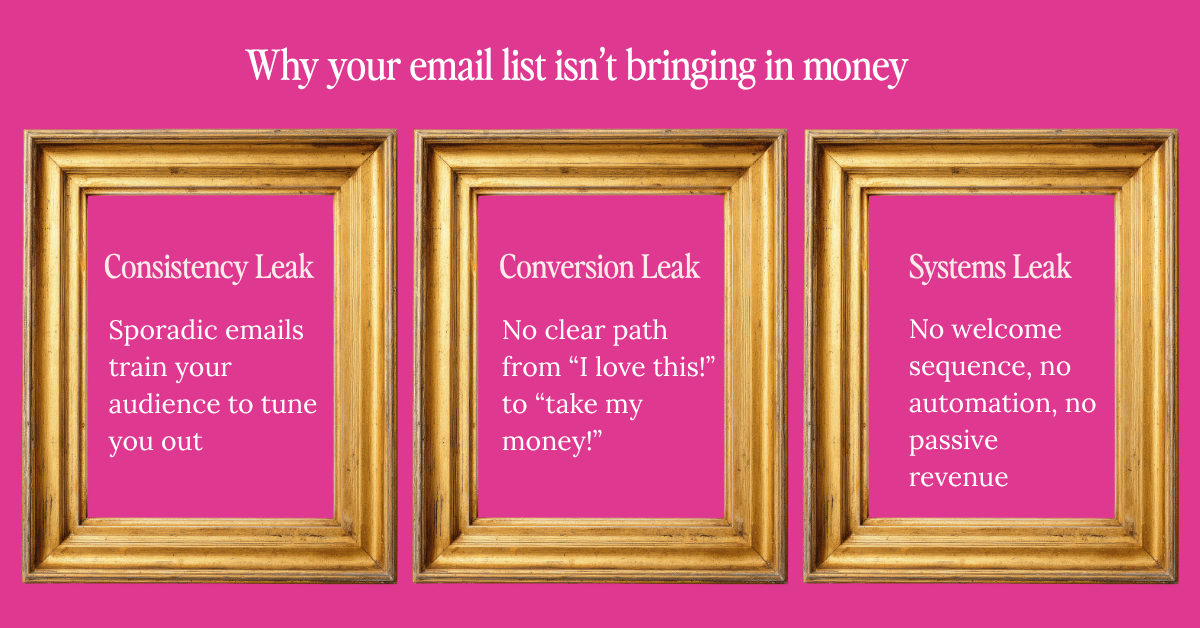
1. The Consistency Leak: Your List Forgot You Exist
If your subscribers don't hear from you regularly enough to remember who you are, you're essentially introducing yourself to strangers every time you show up in their inbox — and then immediately asking them to trust you enough to buy something.
This is one of the most common issues I see, and it's also the most fixable. The mechanics aren't that complicated: when you disappear for weeks at a time (or months — no judgment, it happens), your list goes cold. When you finally reappear, subscribers don't feel familiarity. They feel a vague, uncomfortable "wait, who is this again?"
I worked with a relationship coach who had this exact problem. She'd send emails here and there when inspiration struck, go quiet for a month, pop back up with one or two emails when she had something to sell, then go quiet again. Her list wasn't small, and her content wasn't bad but she'd trained her subscribers to tune her out by being unpredictable. By the time she was in launch mode, emailing her list felt like tapping a stranger on the shoulder and asking for a favor. Or worse, like getting the “hey stranger” text from that “DO NOT ANSWER!” number.
The fix isn't just sending more emails. It's showing up consistently enough that when you do ask for the sale, your audience actually knows who you're asking them to buy from. Current best practices suggest emailing at least weekly: enough to stay top of mind, build trust, and remind people why they signed up in the first place.
Nurture emails are like compounding interest. When you think of each email as a deposit, the habit gets a lot easier to build and the payoff gets a lot harder to ignore.
2. The Conversion Leak: People Love Your Emails and Still Aren't Buying
This one is sneaky. Because from the outside, everything looks like it's working. People open your emails. They reply to tell you they loved it. They might share it with a friend. And then they close the tab and go on with their day.
The problem here isn't your content; your content is clearly good enough that your open rate is decent and people enjoy reading what you send. The problem is that your emails are giving people a permission slip to feel inspired and informed… without ever redirecting that energy toward your offer. If you're not creating a clear, specific path from "I love reading this" to "I need to buy this," your readers will happily keep reading forever without ever becoming clients.
I saw this play out in my own email marketing. People have always liked my emails. (I’m literally a writer – it would be so embarrassing if they didn’t.) And when I began to realize that email was a valuable marketing asset, I started sending them more often, expecting more sales to start rolling in. It, uh, didn’t work out that way. My emails were warm, funny, generous and genuinely helpful. But the calls to action were soft to the point of being almost invisible. Things like "if you're interested, you can always check out the details here." That is not a CTA. That is a gentle suggestion, offered apologetically, to someone who's probably already moved on.
Here's what I want you to hear: strong calls to action aren't pushy. They're actually kind. When someone resonates with your content, a clear, direct CTA does them a favor — it tells them exactly what to do next. We often think merely mentioning our offer is enough. We don’t want to “bother” anyone. But when you hedge and soften every ask, you're not being considerate, you’re actually leaving your warmest leads without a next step.
3. The Systems Leak: Revenue Is Slipping Through the Automation Gaps
This one is different from the other two because it's not about something you're actively doing — it's about what's not happening but could be happening without you doing any extra work.
When you don’t have a welcome sequence – or even just a single welcome email – it means every new subscriber lands on your list and hears... crickets. I had a client who'd built a list of 800 people with zero welcome sequence — every single one of those subscribers landed and heard nothing for weeks. People are literally never more excited to hear from you than when they first discover you. They came across you somewhere and decided it was worth giving you access to their inbox because they think you might have a solution they’re looking for. They signed up with genuine interest, they're as warm as they'll ever be, and you have no automated way to introduce yourself, share your best content, or make an early offer. That window closes unbelievably fast.
No re-engagement flow means subscribers who've gone quiet are just sitting there, dragging down your open rates and never getting a reason to come back.
No automated nurture sequence means every sale depends entirely on your capacity to show up and manually send emails — which, if you're a solo business owner or a small team, means revenue is directly tied to how much bandwidth you have on any given week. That's an exhausting way to run a business. (Ask me how I know.)
The clients I work with who have the most consistent revenue aren't necessarily sending the most emails. They have systems that work in the background, warming up new subscribers, re-engaging dormant ones, and moving interested readers toward an offer — even on the weeks when life gets extremely loud.